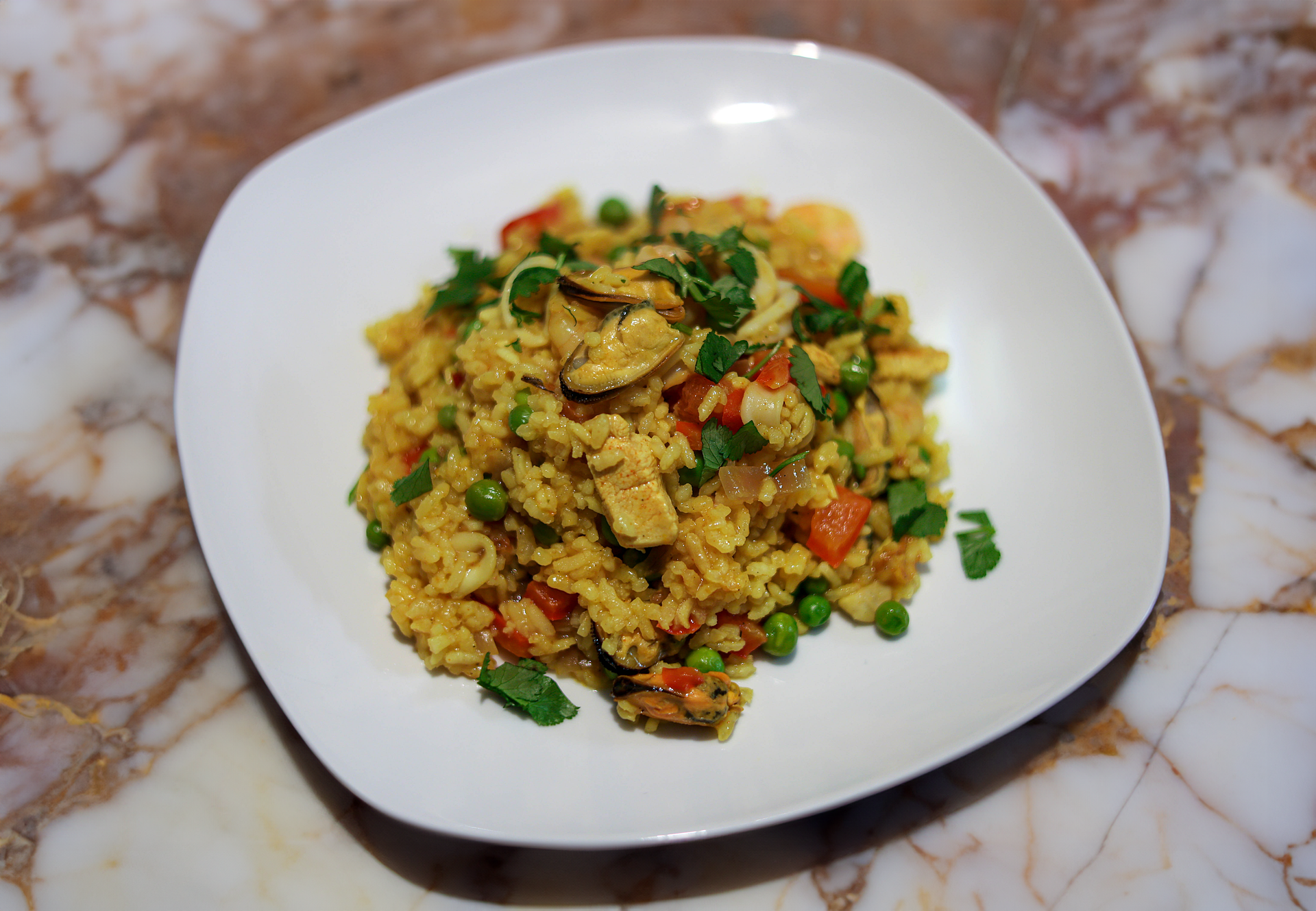
If you walk down the main tourist promenades of Barcelona or Madrid, you will see massive, brightly colored signs advertising “Authentic Spanish Paella.” What they bring to your table is usually a deep pan filled with wet, aggressively yellow rice, drowning in a chaotic mix of frozen shrimp, rubbery calamari rings, green peas, and heavy chunks of smoked chorizo sausage.
This is not Paella. To a purist from Valencia—the eastern coastal region where the dish was actually born—this is a culinary abomination. They dismissively refer to these tourist traps as “arroz con cosas” (rice with things).
True Paella Valenciana is a humble, highly specific dish born in the marshlands and fields, cooked over open fires by peasant farmers. It is a masterpiece of evaporation, rice hydration physics, and extreme restraint. Today, we are going to banish the chorizo, put away the seafood, and learn how to engineer the smoky, deeply caramelized magic of an authentic Valencian Paella.
The Chorizo Ban and the Saffron Mandate
Let us address the most controversial rule immediately: you must never, ever put chorizo into a Paella. When British chef Jamie Oliver published a recipe featuring chorizo, it caused a literal national outrage in Spain. Chorizo is heavily cured with paprika and garlic, and as it renders in the pan, it bleeds smoked red fat into everything it touches. It will completely obliterate the delicate, expensive flavor profile of the dish.
The true flavor and golden hue of Paella come from one of the most expensive spices on earth: pure saffron. Saffron contains a chemical compound called crocin, which provides that brilliant, glowing yellow color, and picrocrocin, which delivers a haunting, floral, slightly metallic earthiness. You must toast the delicate red threads gently, grind them into a powder, and steep them in warm broth before adding them to the pan. Do not use cheap turmeric or artificial yellow food coloring. If you cannot afford saffron, do not make Paella.
The Geometry of the Pan: The Physics of Evaporation
You cannot make Paella in a Dutch oven, a wok, or a deep stockpot. The word “paella” literally refers to the wide, shallow carbon-steel pan it is cooked in. The geometry of this pan is not aesthetic; it is a vital functional tool designed for maximum evaporation.
In a proper Paella, the layer of rice should never be more than half an inch deep—ideally, it should be only one or two grains thick. If the rice is piled deep in a pot, the grains at the bottom will boil, while the grains at the top will steam, resulting in a mushy, uneven texture. The massive surface area of the shallow pan ensures that the liquid evaporates rapidly and evenly, leaving every single grain perfectly cooked, dry, and separate.
The Rice Matrix: Amylose vs. Amylopectin
The choice of rice is non-negotiable. You cannot use long-grain Basmati or Jasmine rice, as they do not absorb enough liquid. You also cannot use Arborio rice (the type used for Italian risotto). Arborio is high in a starch called amylopectin, which dissolves into the liquid when stirred, creating a creamy, porridge-like sauce.
You must use a short-grain Spanish rice, specifically the Bomba or Senia varieties. Bomba rice has a highly unique cellular structure. Instead of expanding lengthwise when cooked, it expands like an accordion, absorbing up to three times its own weight in liquid without bursting or releasing its starches.
Here is the absolute golden rule of Paella: once the liquid is added and the rice is distributed evenly across the pan, you must never stir it. If you stir the pan, you will break the rice grains, release the starch, and create a sticky, creamy disaster. Put the spoon down and step back.
The Authentic Valencian Canvas: Rabbit, Chicken, and Snails
Forget the mussels and the squid. The original Paella Valenciana is a land-based dish. The farmers used exactly what was running around the fields: rabbit, chicken, and land snails.
You begin by aggressively browning the pieces of rabbit and chicken in the center of the pan with high-quality olive oil. The Maillard reaction creates a dark, savory crust on the meat. Next, you add the vegetables: flat green beans (bajoqueta) and large, creamy white lima beans (garrofón).
You then clear a small circle in the center of the pan and build your sofrito—a deeply reduced jam of grated fresh tomatoes, a touch of sweet paprika, and the infused saffron. You pour in your rich chicken or vegetable broth, bring it to a rolling boil, and sprinkle your Bomba rice evenly across the pan in a cross pattern before distributing it flat.
The Holy Grail: The Acoustic Science of the Socarrat
As the liquid aggressively evaporates over the next eighteen minutes, the rice will absorb the saffron, the meat juices, and the rich tomato base. As the broth disappears, you will notice the sound of the pan change.
This is the most critical moment in the entire process. You must rely on acoustic science. The bubbling sound of boiling water will suddenly transition into a sharp, crackling, frying sound. This means all the water has evaporated, and the rice at the very bottom of the pan is now frying directly in the rendered chicken and olive oil.
This creates the Socarrat—the legendary, deeply caramelized, intensely savory crust of toasted rice that bonds to the bottom of the metal pan. It is the most prized part of the dish. Achieving the perfect Socarrat is a tightrope walk; leave it on the fire thirty seconds too long, and the starches will burn into bitter black carbon. Pull it too early, and the bottom will be soggy. You must use your nose to smell the toasted, popcorn-like aroma, and your ears to listen to the crackle.
When it is ready, pull the pan from the fire and let it rest for five minutes. This allows the starches to relax and the remaining surface moisture to vanish.
Serve it in the center of the table. You do not plate Paella. You hand your guests wooden spoons, and everyone eats directly from the pan, scraping the bottom violently to fight over the dark, crispy, caramelized shards of the Socarrat. It is a communal celebration of fire, patience, and absolute culinary precision.