For the vast majority of the Western world, the word “ramen” conjures a very specific, slightly depressing image: a crinkly plastic wrapper, a brick of dehydrated, wavy noodles, and a silver packet of aggressively salty, artificial seasoning powder. Even in many modern restaurants outside of Asia, what is passed off as ramen is often just a lazy, translucent chicken broth dressed up with a splash of cheap soy sauce and a piece of dry pork.
But if you travel to Fukuoka, Japan—the undisputed birthplace of the style—ramen is not a cheap college staple. It is a religion. And the holy grail of that religion is Tonkotsu.
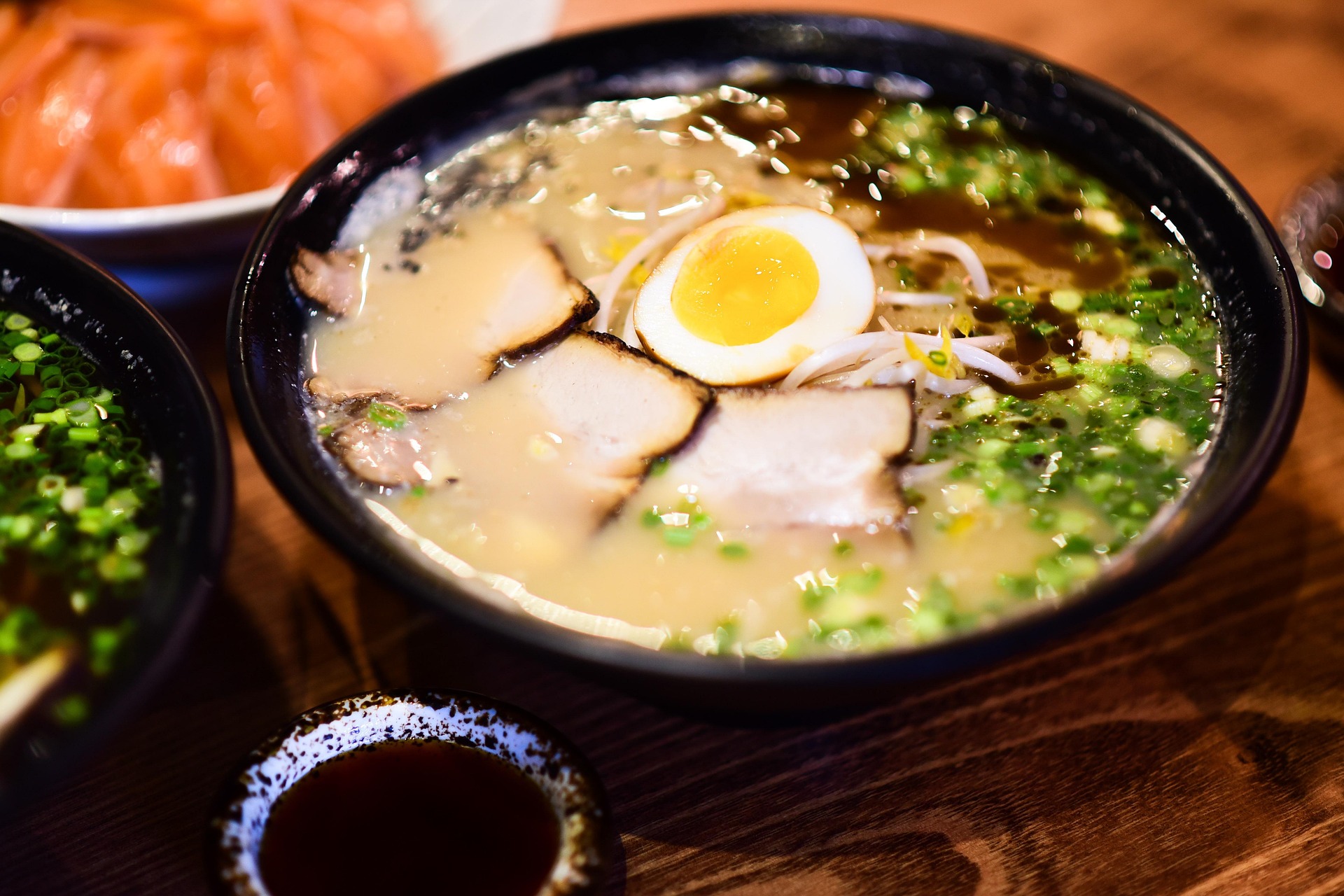
True Tonkotsu ramen is not a soup. It is a liquid emulsion. It is an intensely rich, opaque, milky-white broth forged through the violent, rolling boil of pork bones over twelve grueling hours. It coats the back of a spoon, sticks to your lips, and delivers a payload of umami so profound it temporarily rewires your brain. Today, we are throwing away the flavor packets. We are going to look at the obsessive, borderline-insane science required to build a real bowl of Tonkotsu ramen from scratch.
The Purge: The Secret to a Pure White Broth
If you simply throw raw pork bones into a pot of water and boil them, you will create a disaster. Raw bones are filled with blood, marrow impurities, and dark proteins. If you boil them directly, those impurities will coagulate and dye your broth a dirty, unappetizing grey-brown color, leaving behind an incredibly harsh, metallic taste.
The first step of Tonkotsu is the purge. You must take your pork trotters (pig’s feet), neck bones, and femurs, and plunge them into boiling water for exactly ten minutes. You will watch in horror as the water turns black and foul-smelling scum rises to the surface. Dump the water completely. Take every single bone to the sink and scrub it under cold running water using a brush. You must physically scrape away every speck of coagulated black blood from the crevices of the bones.
Only when the bones are completely pristine can the real cooking begin.
The Violent Emulsion: Breaking the Rules of French Cooking
If you were making a classic French consommé, the golden rule is to never let the pot boil. A hard boil agitates the fat and makes the stock cloudy.
In Tonkotsu, we want the exact opposite. We are actively trying to make the liquid as cloudy and opaque as physically possible. Return your pristine, scrubbed bones to a massive stockpot, cover them with fresh water, and turn the heat to the absolute maximum. You want a rolling, violent, aggressive boil.
You must maintain this violent boil for a minimum of 12 hours. As the water brutally churns the bones, it physically smashes the melted pork fat, the liquified marrow, and the broken-down collagen into microscopic droplets. The gelatin extracted from the joints acts as an emulsifier, forcing the water and the fat to permanently bind together. By hour ten, the bones will literally crumble to dust when you press them, and the liquid will look exactly like heavy cream. It is a masterpiece of culinary physics.
The Soul of the Bowl: The Tare
Here is the greatest secret of Japanese ramen: the giant pot of cloudy pork broth actually contains zero salt. None. If you taste the 12-hour Tonkotsu broth directly from the pot, it tastes like rich, unseasoned pork fat.
The actual flavor of ramen comes from the Tare (pronounced tah-reh). The Tare is a highly concentrated, incredibly salty, umami-bomb seasoning liquid placed at the bottom of the empty serving bowl before the broth is ever added.
For a classic Shoyu (soy sauce) Tare, you do not just use straight soy sauce. You must slowly heat a high-quality Japanese soy sauce with sweet Mirin, a splash of sake, a piece of dried Kombu (kelp), and a handful of Katsuobushi (smoked, fermented skipjack tuna flakes). The kelp provides naturally occurring glutamates, while the tuna provides inosinates. When these two chemical compounds meet in the Tare, they multiply each other’s umami impact by up to eight times.
The Science of the Snap: Alkaline Noodles
You cannot put standard Italian spaghetti or standard wheat noodles into a bowl of Tonkotsu. The intensely rich, heavy broth will turn regular noodles to mush in less than two minutes.
Ramen noodles are entirely unique because they are made with Kansui—an alkaline mineral water. Introducing alkaline salts (potassium carbonate and sodium carbonate) to the wheat flour changes the pH level of the dough. This chemical reaction does two things: it turns the noodles a beautiful, natural yellow color, and it fundamentally alters the gluten structure. The resulting noodle is incredibly dense, springy, and capable of holding its chewy texture (its “snap”) even while completely submerged in boiling hot, fatty liquid.
The 30-Second Assembly Window
A bowl of ramen is not casually plated; it is assembled with military precision. A bowl of ramen begins dying the second it is built.
Preheat your ceramic bowl with boiling water, then dump it. Add exactly two tablespoons of your concentrated Tare. Ladle in the boiling hot, milky Tonkotsu broth and watch it mix with the dark soy seasoning.
Your alkaline noodles take exactly 60 seconds to boil. The moment they are done, drain them violently to remove any excess water that would dilute the soup. Fold them neatly into the broth like a folded ribbon.
Top immediately with slices of Chashu (braised pork belly that melts on contact with the hot soup), a handful of sharply chopped scallions to cut the fat, a sheet of crisp Nori seaweed, and the legendary Ajitsuke Tamago—a soft-boiled egg marinated in soy and mirin with a glowing, jammy, deep-orange yolk.
Serve it instantly. Do not talk. Do not wait. You lean over the bowl, you inhale the rich, smoky, pork-scented steam, and you loudly slurp the noodles to aerate the fat. You are no longer just eating dinner; you are experiencing twelve hours of engineered perfection in a single bowl.